Dean Fraser, artist of the Springfield Punx series, enjoys taking pop culture characters (and real people) and turning them into Simpsons-style characters. When you go to his website, you'll find that he has a healthy obsession with all things related to Batman (he has at least four different variations on The Joker and three on The Penguin), and he's currently doing a series of Lost characters (Ben Linus, Charlie, and Hurley). I really enjoy and appreciate the work he does, and I hope you do too. His Arrested Development series (including some secondary characters!) is especially entertaining.
Update, May 30th: Here are some Lost characters. (l-r) John Locke, Ben Linus (he does get beat up a lot), and Sawyer (aka Jim LeFleur)
(l-r) Rorschach from Watchmen, Marty McFly and Doc Brown from Back to the Future
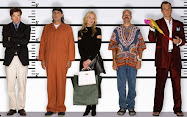
(l-r) Dwight from The Office, Captain Freakin' Planet, Dr. Greg House from House
Late Night Gods: (l-r) Steven Colbert, Craig Ferguson (complete with yodeling monkey!), and Conan O'Brien
Arrested Development alert! (l-r) Tobias "I Think I Just Blue Myself" Fünke, Steve "Steve Holt!" Holt, and Buster "I'm a Monster!" Bluth
Between seasons 2 and 3 of Lost the writers and producers created an alternate reality game (ARG) known as The Lost Experience. In short, it was intended to engage the audience in a narrative that would be too difficult to tell on the show itself. Videos were created and hidden on the internet, following a band of contemporary characters following the Dharma Initiative and the Flight 815 hoax. The Lost Experience supposedly followed the story of Lost, and those who chose to engage in the experience would be rewarded with extra information while those who didn't follow the game (and only watched the show) would not be missing anything. And for the most part, that's been true. I stopped following easter eggs on the internet after season 3, but there is one part of the Lost Experience that has become part of the mythology for me, a major part that has yet to be addressed on the show: the Valenzetti Equation.
The Lostpedia website explains:
According to the 1975 orientation film in the Sri Lanka Video, the Valenzetti Equation "predicts the exact number of years and months until humanity extinguishes itself." During the video, Alvar Hanso also states that the radio transmitter on the Island, will "broadcast the core numerical values of the Valenzetti Equation." The numbers, 4, 8, 15, 16, 23 and 42, are explained in the Sri Lanka Video, as the numerical values to the core environmental and human factors of the Valenzetti Equation. Alvar Hanso also states in the video that the purpose of the DHARMA Initiative is to change the numerical values of any one of the core factors in the equation in order to give humanity a chance to survive by, effectively, changing doomsday. However, Thomas Mittelwerk reveals that as of 2006, they have failed to change the values through manipulating the environment, as the equation continues to arrive at the same six numbers.
The equation, therefore, is a mathematical prediction of the end of days, and Dharma is part of the experiment to change the equation. So here are my questions: (1) Why hasn't the show explained either the Valenzetti Equation or Dharma's purpose? Having just finished season 5, I would think the Cuse and Lindelof would have incorporated this background information into the story by now. Changing the equation explains why Dharma is experimenting with polar bears in tropical climates, electro-magnetism, and time-travel (the bunnies). (2) The purpose of the numbers 4, 8, 15, 16, 23, and 42 are still being depicted on the show as coincidental. When they were etching the numbers into the Swan's door, why wasn't there an explanation as to why those numbers were chosen? And (3) the show is heavily invested in this idea of variables. If the following theory is correct (which I attribute entirely to my mother), then why hasn't the Valenzetti Equation been mentioned?
If the show does not incorporate the Valenzetti Equation into the last season of the show, I will be very disappointed. The following explanation of the show has allowed me to accept and appreciate the characters, their ridiculous circumstances (and even more ridiculous decisions), and to embrace the tone of the show rather than merely criticize the reality of it.
The End-All, Explain-All Theory (that makes Lost better than it actually is)
If we assume that changing the Valenzetti Equation is in fact part of Lost's mythology -- and I really hope it is because it explains so much (for a show that explains so little) -- then we can connect Jacob and Esau's "game" to the equation as well. Let's say that Jacob and Esau are god-like characters (not necessarily the Judeo-Christian God, but some sort of metaphysical beings), who are engaged in an eternal debate concerning the quality of humanity. To borrow the over-arching question of Battlestar Galactica -- Is humanity worth saving? Season 5's finale began with Esau stating, "They come, fight, they destroy, they corrupt. It always ends the same." It refers to the cycle of destruction in humanity's history, and cyles are traceably mathematical in nature, so Esau could be representative of the Valenzetti Equation. He predicts and awaits for humankind of destroy itself. (I will ignore, for now, what the loophole is and why Esau is intent on killing Jacob. Perhaps Esau isn't interested in saving humanity.) Jacob's duty, therefore, is to prove to Esau that humanity is worth saving -- that the outcome of the equation/cycle can be changed -- by choosing randomly selected individuals to represent the human race.
The random selection is important. Sure, Jacob could have chosen Buddhist monks or philanthropists to come to the island, but the point is that humanity is flawed. Our heroes are flawed. Our heroes make mistakes. Our heroes are not incredibly intelligent. They are average people who are conflicted between their hearts and their heads, between doing what is right and doing what is necessary. And as Daniel Faraday mentioned before he died, our characters are the variables. Not variables in time travel, but variables in the equation. Faraday noted that free will is what changes the course of history. Our heroes were chosen to save humanity through their choices.
In the finale, Jacob is reading Flannery O'Connor's Everything that Rises Must Converge collection of short stories outside of the hospital where Locke's father pushes him out the window. Wikipedia describes the collection as follows:
In the story after which the work is titled, human weaknesses are exposed and important moral questions are explored through everyday situations. Critics view the story as a prime example of O’Connor’s literary skills and moral views. [...] Through irony, the blindness and ignorance of the characters are exposed. The title Everything That Rises Must Converge refers to an underlying religious message central to her work: aiming to expose the sinful nature of humanity that often goes unrecognized in the modern, secular world.
O'Connor is compassionate to her characters in that she gives them the opportunity of receiving grace, however devastating that might be to their fragile self-images, as well as their fragile mortal frames, for in O'Connor, grace often comes at the moment of grisly death.
In a letter written to Winifred McCarthy, Flannery O'Connor writes, "There is a moment in every great story in which the presence of grace can be felt as it waits to be accepted or rejected, even though the reader may not recognize this moment." [...] Critic Carter W. Martin notes, "Most of the short stories are constructed in such a way as to dramatize the sinfulness and the need for grace..." and goes on to delineate two different kinds of grace normally received by the characters: "prevenient grace-- which moves the will spontaneously, making it incline to God--and illuminating grace, by which God enlightens men to bring them nearer to eternal life." That is to say either a kind of spark that ignites a low smolder of realization, or full-blown revelation. Usually the character "recognizes his need for repentance and either accepts or ignores the opportunity.
In "The Incident: Part I and II," many of the characters have a moment of reaching grace -- hence the significance of Jacob's flashbacks. (Earlier I mentioned that I didn't like the flashbacks, but considering that Jacob was present for each character's moment of grace, I now appreciate their relevance to both the characters and the mythology of the show.) Kate promises to near steal again, but we all know that she chooses to rob a bank later in life (which leads to the death of her childhood friend). Sawyer's decision to write a letter to the man who killed his parents is thwarted by an inkless pen. Jacob gives him a new pen, allowing him the choice to continue writing the letter. A friend of the family tells young James Ford not to finish the letter, but we know that he chooses to finish it later. Locke is essentially killed by his father but is revived from Jacob's touch. This is the moment where Locke is given a second chance at life. He can go on being pathetic and miserable (a failed relationship, daddy issues, etc.) or he can choose a life of adventure. His infamous line -- "You cannot tell me what I can and cannot do" -- places the decisions of his life solely in his hands. Despite being in a wheelchair, he chooses to do a walk-about. When faced with killing his father, per Ben's instructions, Locke chooses to ask Sawyer to do it (which is arguably Sawyer's moment of choice as well). Sun and Jin, our resident couple of institutional love, get married and vow to honor and love one another. But we all know that Jin chooses to work and murder for Sun's father and that Sun chooses to have an extramarital affair. Their moment of grace comes through their separation in time. Three years after the time split, Sun and Jin refuse to let go of the idea of finding one another. (Love, my friends, love is what will save humanity.) With Jack and Hurley, they are both at a crossroads -- Jack with quitting his job and Hurley with being released from prison. They can continue moving forward, or they can change direction altogether. As Jacob points out to Hurley, he doesn't have to get on the Ajira flight. He could have chosen to walk away.
And most importantly, Ben has the choice to kill Jacob. Perhaps it is because Jacob knows how Ben will choose -- Ben does have quite the history of killing people (let's not forget about The Purge) -- that prompts him to tell Ben, "You? What about you?" He says it with such sadness, not because he knows that he is about to die but because Ben represents everything that is greedy and immoral about humanity. Ben could have walked away. But he didn't. He chose to kill Jacob, hence Esau's victory burial of Jacob in the fire.
The entire series of Lost has been about choices. Originally it was about the choices of Jack versus Locke, but when you consider all of the flashbacks throughout the series, it makes a lot of sense that these flashbacks serve to illustrate not simply the type of character each individual person is, but also how they come to make choices. What outside influencing factors help determine their path? What do they choose to ignore, what do they choose to embrace? And most importantly, how is their moment of grace significant to the Valenzetti Equation? Sawyer sacrificed himself by jumping out of the helicopter. Kate returned to the island to find Claire. Jack and Juliet, the rational characters, are willing to "reset" history for love. Charlie sacrificed himself for Desmond and the others. Michael died as a means of redeeming himself for leaving the island. A majority of these deeply flawed characters have already had their moment of grace, that moment where they undoubtedly answer the question -- Yes. Yes, humanity is worth saving.
Bones: I am extremely irritated with this show. The season four finale, "The End in the Beginning," offered viewers an immediate look at Brennan and Booth in bed together -- something the creators have sworn up and down would be real and not a hallucination or a dream -- only to discover that it's not actually Brennan and Booth. While the real Booth has been in a coma for the past four days, the audience learns in the last two minutes that Brennan has been writing a crime short story/book based on people she know. The following are my major irritations: (1) First of all, the actual story she writes -- complete with a lame Hodgins voiceover -- isn't a very good story. (2) Secondly, it took me an entire forty minutes to figure out where this bizarro world came from. These are characters I know, and yet somehow they're not... oh, it's a story. Told by someone. For some reason. That won't be revealed until the last two minutes of the show. Because the writers didn't introduce it as a story (but rather immediately leapt into bed with Booth and Brennan for cheap thrills), I spent a majority of the hour waiting for the end of the episode. I didn't care about these bizarro characters with their bizarre personalities. I wanted to get back to the normal Bones world I had grown to love. The only thing I liked about this world was that it showed how well John Francis Daley (Sweets) can sing. (3) And lastly -- and this is a major problem -- there was no chemistry between the lead actors during their sex romp. This could be because of two reasons. One, the sex came at the very beginning of the episode, and because there was no build-up, the scene couldn't climax (much like the characters, I'm sure). Without the build-up, there's no audience investment. Or two, randomly beginning the episode in bed -- with Booth in a hospital bed in the last episode -- lead to a lot of confusion. So instead of enjoying the moment for what it was, the audience scratched their heads and wondered what happened between last week and this week that allowed Booth to be healthy enough to engage in sexual relations. Outside of these two possibilities, the scene simply didn't work. It was awkward and the actors seemed to be pulling back. (The actors are friends in real life, so I bet it was like kissing a sibling on the set.) But most of all, imagining a story is the exact same as dreaming. Brennan and Booth still have not had sex, something the creators have been promising since mid-season. I'm angry. I feel cheated. And the fact that this show has been renewed for two more seasons really worries me.
The Office: Hands down, the finale "Company Picnic" was the best thing on television last Thursday. It was able to balance the multiple strengths of the show, including sight gags and verbal jokes, outrageous caricaturizations (which Blogspot informs me is not a word, but then again, neither is Blogspot) and quiet moments of heart-tugging goodness. Steve Carrell and John Krasinski really brought their A-game to this episode, and the writers pulled off a wonderful showcase of the often times overlooked or ignored supporting cast. Stanley had the winning line of the night: "I usually don't enjoy the theater, but this is delightful." The episode began with a wonderful prank on Michael -- wonderful because it's based in reality (what office employee doesn't dream of taking advantage of their boss and skipping out on a full day of work?) -- and it was nice to see Dwight get in on the prank. And yes, I enjoyed Dwight's awful pun while changing the clocks, "Like clockwork." And then the episode follows our favorite Scranton Branch into the Dundler-Mifflin company picnic, where hilarity ensues on the volleyball court and we discover, through one of the sweetest moments of the show, that Jim and Pam are pregnant. It's a scene that is right above the proposal (for its style of execution) and just below the kiss from "Casino Night" (only because nothing will ever touch the awesomeness of that moment). The reveal came through a window in the hospital (begin watching at the 20:14 mark), and we see the look of shock and awe on Jim and Pam's face, right before they kiss each other and Jim starts crying. Then he comes out to call Dwight with the sweetest line of the episode, "Dwight, send in the subs." Way to make my heart swell, Krasinski.
Below are some of the highlights: • I loved the introduction of Dwight's best friend, Rolf -- "I met him in a shoe store. I heard him asking for a shoe that could increase his speed and not leave any tracks." -- mostly because I will never tire of anyone calling Angela a whore. • Michael wrote down a list of why he and Holly are soul mates -- "Holly and I are soup snakes, and the reason is... in terms of the soup... that doesn't make any sense. We're soul mates." -- and was smart enough to know he should wait to tell her of his affections. Michael Scott is only as self-aware when he's around Holly. • I'm going to miss Idris Elba as Charles, Michael's interim manager while Michael created the Michael Scott Paper Company. In this episode, his competitive nature really heightened his character's contempt for the Scranton Branch, namely Jim. This is a very specific type of character that would work well within the Office universe. Best line: "It must be nice to get a rest from all your rest." • Michael and Holly's skit, "Slumdunder Mifflinaire," worked so well despite its obvious awkwardness (Michael announces the closing of a branch, when said branch is present without any knowledge of the layoffs) because of Steve Carrell's Indian accent and because they made torture into comedy. This skit, by the way, really showcased why the show will suffer the loss of Amy Ryan next season. Michael and Holly chanting "Dun-der, dun-der, dun-der" to the tune of the Jaws theme song was as sweet as anything Jim and Pam have ever done. • Pam played volleyball in junior high, high school, college, and went to a volleyball camp most summers -- and she's proud of it. • Best site gag: As Kevin is speaking into the camera -- "It's 6 to 6. It's a nail biter." -- he gets hit by the volleyball. Unexpected physical pain is always welcome. (And this was followed by Angela asking Kevin, "Now it's 7:6. Or is that too much accounting for you," to which Rolf says, "Here's an accounting question for you. What does one fiance plus one lover equal? Answer: one whore.") • Second best site gag: To delay the game while Jim takes MVP Pam to the hospital, Dwight kicks the volleyball into the woods with such anger and then yells, "I'll get it!" and saunters away. I laughed embarrassingly hard.
Grey's Anatomy: The finale "Now or Never" was certainly the talk of Facebook on Friday. (Sadly, Facebook statuses have replaced "watercooler talk.") I don't have much to say outside of George and Izzie's storylines -- other than someone needs to give Chandra Wilson (Bailey) an Emmy already, and then more Emmys for the previous seasons that she hasn't won -- so I'll stick to those major characters. (1) Izzie: When she emerged from her surgery with short term memory loss, I immediately thought back to a previous episode where a woman had to be told every 30 seconds that her husband died on his way to the hospital. At first I was peeved because I thought they were recycling material, but then I realized the familiarity of the storyline was supposed to evoke a response to tragedy. What if Izzie had to be told over and over again that the tumor was removed? It's not as heartbreaking when compared to the woman whose husband died, but the source of one's identity is very much rooted in memories. Eating jello (action) is not as defining as remembering whether or not you like jello (memory). We all knew that Izzie's memory would eventually come back, but it was wonderful to see it come back in such an honest way. Her husband Alex delivers one hell of a speech about his fears, which makes Izzie hold on to his words and thus focus on remembering. His speech, delivered so well by Justin Chambers, included thoughts on leaving her, on feeling helpless, on her not being the same person he married. It wasn't sweet; it wasn't romantic. It wasn't anything anyone would ever want to hear after going through brain surgery. But damn was it honest.
(2) George: I didn't realize George was the John Doe on the table until the Chief said he sent O'Malley home early to be with his mother before he departed for Iraq. Creator Shonda Rhimes has noted that the writers deliberately edged George out of major storylines so that when he was absent in the finale, nobody would take notice. Well Shonda, it worked. I was completely taken by surprise. (Rhimes has also noted in previous seasons that she pitches the season's finale before they even begin writing that season, so I believe her when she says it's merely coincidence that Katherine Heigl and T.R. Knight have been publicly scrutinized for their roles in the show and that they're the ones who end up flatlining at the episode's end.) There are two reasons why George's storyline broke my heart. The first is all due to Ellen Pompeo. Her delivery of "007? 007! 007! Oh my God, oh my God. It's George!" will forever be etched in my memory. Broke. My. Heart. (Best thing Pompeo's done on the show yet.) And second, in the first hour of the two-hour finale, George-as-John Doe is on the operating table, being poked and prodded by all of the major surgeons, including his ex-wife Callie, his mentor Owen Hunt, and his friend Meredith Grey. John Doe stepped in front of a bus to save a complete stranger from being hit, and someone wonders aloud if anyone thinks they could ever do that for someone else. Callie says, "We like to think we would, but... [we wouldn't]." That's our George. George is the type of person to step in front of a bus for someone else. The way that these scenes were set up -- thinking of John Doe as some random patient in the beginning, then realizing that the patient is our heroic George towards the end -- was extremely well plotted. For the most part, the finale was a typical episode... but the last few minutes, where Izzie and George both simultaneously flat line, left a lot of fans screaming at their television, "SERIOUSLY?!?"
30 Rock: My biggest issue with this show is that the jokes are often isolated within specific scenes -- and further, those scenes are isolated from other scenes -- so it was nice to see Liz's fifth grade kidney performance brought back to reveal she went to school with Sheryl Crow. Overall, the episode was just okay, but I didn't care for the forced catchphrase storyline (despite it being funny, it was so self-aware that the irony was quickly replaced by the idea that NBC is making 30 Rock catchphrase central -- even their website has "It's a deal breaker, ladies!" everywhere), or Tracy Jordan going back to high school to deliver a commencement speech. The episode did have one great moment, and that's the closing charity song ("One song. One man. One kidney."), filled with the voices of Mary J. Blige, Elvis Costello (alias of an international art thief), Clay Aiken, Cyndi Lauper, Adam Levine, and many others. It was more parodic than the straight-laced "The American Dream" song from Wag the Dog, and I do enjoy a good mocking of consumer capitalism.
• Dr. Spaceman was used remarkably well in this episode, from "Kidney transplantation is no laughing matter, so I apologize... (insert childish laughter)... kidney is just such a funny word" to yelling "Opposite! Opposite!" at the kidney transplant form. • Here's a complete list of the catchphrases Liz Lemon offers to various women throughout the episode: "This guy's making you talk like a crazy person. You have sexually transmitted crazy-mouth. That's a deal breaker." "Your fiance's gay. Look at him, look at you. Classic case of 'fruit blindness.'" "He thinks he deserves a va-jay-jay upgrade. He doesn't; he's not Tom Brady. Shut it down." "There's no such thing as bisexual. That's something they created in the 90s to sell hair products." "Only one snake in the bed. Deal breaker!" "Not on my watch, beyotch." "S to the D. Shut it down." "Talk it out before you walk it out." "Long distance is the wrong distance." • Say what you will about Tracy Morgan as an actor or a human being, his performance as Tracy Jordan makes even the worst storylines so much better. The "When have I ever cried" montage was hysterical. In case you've ever wanted to revisit some of Tracy's best lines, you can go here and read every line he's ever uttered. • Here are the lyrics to the charity song:
Sometimes life brings pain and strife, and all seems wrong. That's when you find a friend and write a song. So give the gift of giving, and give it far and give it wide. Take the leap pushed down deep inside. And just give a kidney to a father or a dad. Just give a kidney. We hear it doesn't really hurt that bad, and we know you want to give it to a super human being (?). So get it done. We just need one. For Milton Green. This country has six hundred million, and we really only need half, which still leaves three hundred million kidneys. Do the math. Milton Green (x a lot). He needs a kidney. Milton Green. Don't ask why, he could die if you don't call today. Listen, when someone starts talking in the middle of a song, you know it's serious. So give Milton a kidney. We all believe in this cause so much that we're doing it for free. Except for Sheryl. And only three of us are drunk.
The song continues, but it moves so quickly between the celebrities... but the highlight was Cyndi Lauper exclaiming, "I'm one of the drunk ones!"
I am going to preface my review by saying that I used to mock my father -- and still do, really -- every time he shouts "I've been there!" during a location shot in movies. Italy, France, Turkey, England... he's been to many a far off lands, so imagine how often I've had to endure the phrase, "I've been there!" But then something happened. He took me to England. He took me to France. And he took me to Italy. So now whenever I see the Gherkin or Piazza San Marco, I exclaim with childish glee, "I've been there!" and he becomes the one mocking me. I went to see Angels and Demons with him yesterday (as well as my equally well-traveled mother), and having walked around Rome with the explicit intent of following the path laid out in Dan Brown's novel, I sat in my seat, squirming and beaming with extreme sensory recognition. Raphael's Chigi Chapel. Bernini's St. Teresa in Ecstasy in Santa Maria della Vittoria. Raphael's tomb and the occulus in the Pantheon. The Baldacchino (which rests above St. Peter's tomb) in St. Peter's Cathedral. Between receiving my undergraduate degree in art history and walking the exact path of protagonist Robert Langdon, I was geeking out throughout the entire movie, suppressing the urge to scream "I've been there!" over and over and over again.
With that said, I have no idea if this is a good movie. I walked away feeling pleased, but that's because I've been there and there and there. Some quick notes: First, Ayelet Zurer, who plays the female lead Vittoria, is infinitely better cast than Audrey Tautou in The da Vinci Code. Second, this film is heavy on exposition -- but, unlike Duplicity, the scenes move along quickly and the narrative unfolds at an entertaining pace -- and, although I had no personal dissatisfaction with it, I can understand how anyone unfamiliar with either Rome or art history might get lost along the way. Third, the film starts with a short introduction to CERN and their large hadron collider, which is one of my favorite things ever. The science behind the scene is reductive and oversimplified, but I suppose that's necessary to move the plot along. Still, this allows me a good opportunity to share some links:
And lastly, the film explains the Illuminati's mission in one scene, and if you happen to zone out during that scene or leave to use the restroom, you will miss the secret organization's motive. Also, Langdon does not explain -- at all, if I'm remembering correctly -- why the eye, obelisk, or pyramid are associated with the Illuminati. He just says, "An eye within a pyramid! The sign of the Illuminati!" and you're supposed to accept it. On the plus side, the film revisits the science vs. faith dichotomy enough times that even if you don't understand who exactly the Illuminati were, you at least know why they existed.
The film, of course, made damn sure that it offended neither religious people nor atheists, which actually disappointed me. (Not that the film wasn't insulting, but because there was no real debate between any of the characters.) The head Swiss guard and the camerlengo are quick to point out Langdon's atheism, but he has a private audience with church officials at the end that makes everything copasetic. The political correctness just seemed a little forced. Many members of the papal court -- particularly the head cardinal -- are suggested to have a duplicitous nature (he's religious but with immoral motivations!), but there are many positive conversations about the necessity of faith and religion. As an agnostic, I always appreciated Dan Brown's handling of this debate, and I was sad that my favorite part of the book was not included in the film.(*) In the book, the camerlengo (played in the film by Ewan McGregor) grabs a news reporter's microphone and gives a message to those watching coverage of the papal conclave. Included in that message, he says to the non-believers, "You look at the stars and you say, 'How can there be a God?' I look at the stars and I say, 'How can there not be a God?'"(**) I've always referred back to this scene when people ask me to explain why I'm agnostic (which they incorrectly perceive as "fence-sitting").
(*) Although this scene was not in the film, there are other scenes that state quite plainly that science and religion are not, or should not, be contradictory. (**) I do not have a copy of the book on me at the moment, and I have not read the book in a few years. This is a scene that I pulled from memory, so there is a good chance the wording is entirely incorrect.
I'm fairly certain I enjoyed the film, though I know others may not be as forgiving as I am. Whenever my brain contemplated a plot hole (the set-up of the goose chase is pretty implausible, considering the limitations of the villain), I just remembered Bernini's sculptures. When the movie was over, I ran into a friend who said she was less than impressed, but then, she's never been to Rome.
Upfront Week doesn't technically begin until today (Fox on Monday, ABC and NBC on Tuesday, CBS on Wednesday, and CW on Thursday), but already Ausiello has a cheat sheet listing those shows that have been renewed. Here are some highlights, and by that I mean shows that interest me the most (and because reality TV is the bane of my existence, you will not find any of those listed here):
ABC Better Off Ted: RENEWED. Whoo hoo! Brothers & Sisters: Renewed. Castle: RENEWED. Cupid: Canceled. Yeah... this remake was alarmingly bad. Desperate Housewives: Renewed. Forever. Eli Stone: Canceled, and the last of this past season should finish airing this summer. Grey's Anatomy: Renewed. Lost: Already Renewed. Pushing Daisies: Canceled, and the last of this past season should finish airing this summer. Scrubs: Renewed, with Sarah Chalke and Zach Braff returning for six episodes. The Unusuals: Canceled. Too bad; the actors had great chemistry together.
CBS The Big Bang Theory: Renewed for two seasons. How I Met Your Mother: Not official, but it'll most likely be renewed. The Mentalist: Ditto. It's the number one show on television.
FOX 24: Renewed. American Idol: Renewed. Ugh, go away. Bones: Renewed for two seasons. Dollhouse: Renewed for thirteen episodes. Family Guy: Renewed. Fringe: Renewed. House: Not official, but it'll most likely be renewed. The Simpsons: Renewed. Terminator: The Sarah Connor Chronicles: Canceled.
NBC 30 Rock: Renewed. Chuck: Renewed for thirteen episodes, but with a tighter budget. They'll probably be getting rid of a character, or at least decrease the number of episodes the supporting cast is in. Heroes: Renewed. Ugh, go away.. The Office: Renewed. Parks and Recreation: Renewed.
Looking back over this list, I can't help but think... man, I watch a lot of television.
Isaac Spaceman over at Throwing Things wrote the following in a recent post, which I found to be quite insightful. Perhaps Lindelof and Cuse actually have this thing well plotted out...
I thought it was an excellent (but not pantheon-level) Lost, but mostly I was impressed with how intricately-written it was, weaving together not just the basic mythology, the Romeo and Juliet B-story, the turtles-all-the-way-up (tm Carmichael Harold) escalating conflicts (survivors vs. survival; survivors vs. Others; Others vs. Dharma; Ben vs. Widmore; Jacob vs. Esau), but also a number of allusions to prior season finales. To be clear, I'm not saying these are coincidences or minor similarities, in the nature of a high-school "compare and contrast" paper. I think these were explicit callbacks to the prior finales and restagings of pivotal scenes or shots. To wit:
• In the Season 1 finale, "Exodus," Jack takes a volatile explosive (old dynamite) from an anachronistic source (an inland-beached galleon) and carries it in a backpack to the Swan hatch, to blow it up. In "The Incident," Jack takes a volatile explosive (a plutonium core rigged to blow on impact) from an anachronistic source (an underground Egyptian temple) and carries it in a backpack to the Swan hatch, to blow it up. "Exodus" ends with the camera going down the hatch. "The Incident" ends with the camera going down the hatch (though it is shot in the accelerating style of the last shot in the pre-credits opening of the
• Season 2 opener, "Man of Science, Man of Faith," when the camera went the other direction). The Season 2 finale was "Live Together, Die Alone." In "The Incident," Juliet answers Sawyer's "what do we do, Blondie?" question with "Live together, die alone." The climax of "Live Together, Die Alone" is the implosion of the Swan, followed by Desmond, laying underneath the station, turning the failsafe key, triggering a fade to white. In "The Incident," the Swan implodes, followed by Juliet, laying underneath the station rubble, beating the bomb with a rock, triggering a fade to white.
• In the Season 3 finale, "Through the Looking Glass," Ben asks to speak with Jack alone before Jack does something that will cause everyone on the island to die. "The least you can give me is five minutes," he says. "Five minutes," Jack responds, and Ben invites Jack to "have a seat on the rock." In "The Incident," Sawyer asks to speak with Jack alone before Jack does something that will cause everyone on the island to die. "I need five minutes, that's all ... you owe me that much, Jack," says Sawyer. "Five minutes," replies Jack, and Sawyer invites Jack to "take a load off" on the rock. Also, in "Through the Looking Glass," Hurley rides to the rescue in a Dharma microbus. In "The Incident," Hurley rides to the rescue in a Dharma microbus.
• The big reveal in Season 4's finale, "No Place Like Home," is that the object in the box is Locke's corpse. The big reveal in "The Incident" is that the object in the box is Locke's corpse.
Also, in Lost-related news, I recently discovered Jorge Garcia's blog, and he seems like a really awesome guy. Between the hilarious photo captions ("I think that guy flipped me off.") and all of the misadventures he seems to have (cake batter in a spray can, really?), it's a lot of fun to read. In another life, I'm sure he and I would be BFF -- all because of a simple photo frame.




.jpg)


.jpg)
